
Jean Pierre plucks a small, five petalled flower, pale yellow against the dark green leaves. It has a long slender stem. He looks over his glasses and with his rough cement grimed fingers pinches the tiny filament of stamen just visible in it’s centre. He does the same with another, and then gently inserts the stem into the hole where the stamen had been. Gradually a chain is built. Nick, you must always be romantic, he says earnestly. Me, I love flowers. You make this for the ladies, his eyes light up. You see.
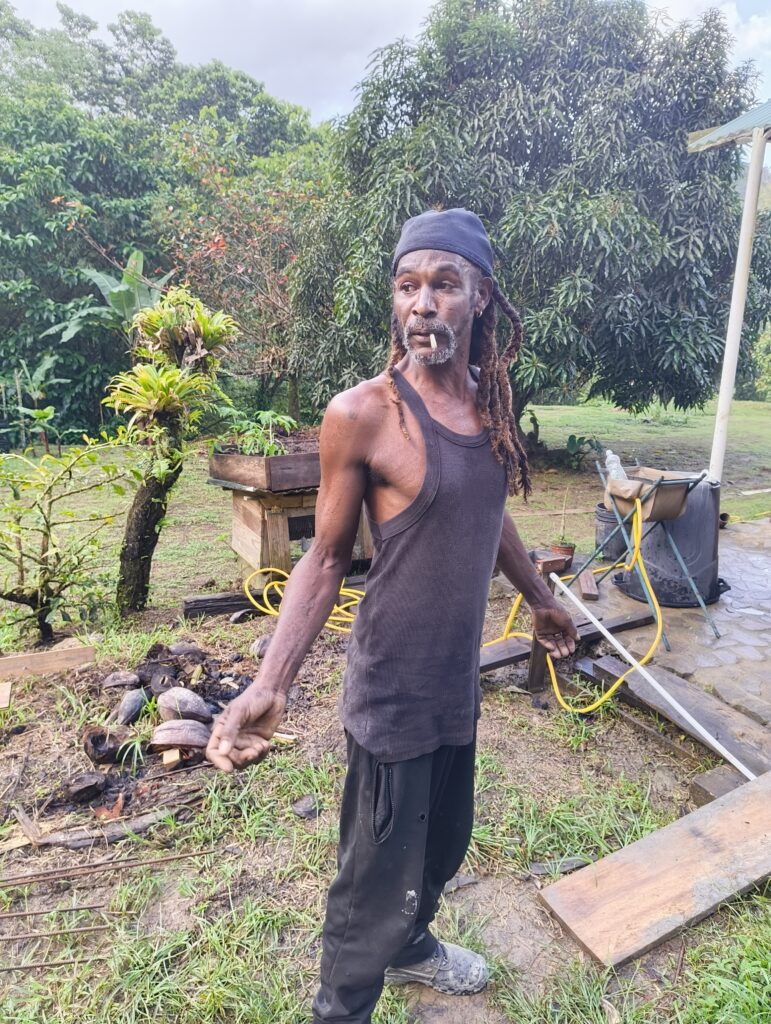
He is known as the Frenchman, or JP, or Dieu Dieu. All people are Dieu Dieu to him. He lives between Guadeloupe, Martinique and Dominica, but here is where he loves to be. When they were small, eight or nine, Edo brought him home. His grandmother set one bowl on the table and gave them each a spoon. A brother from another mother is what they say.
The image of the stamen, like a fragile human hair with a dusting of pollen on top, teased out and ever so briefly becoming a chain made with love, for love, stays with me.
There are tiny ants in my granola. I watch them move, like embers thrown out from a blazing fire. They scout continually, a solitary millimetre long explorer, scouring all surfaces for the tiniest grain of food. The lid of the tupperware shielding the sugar remained unclipped in one corner – a feast! Even with my glasses on, I have to stare for a good while to spot their frantic movements.
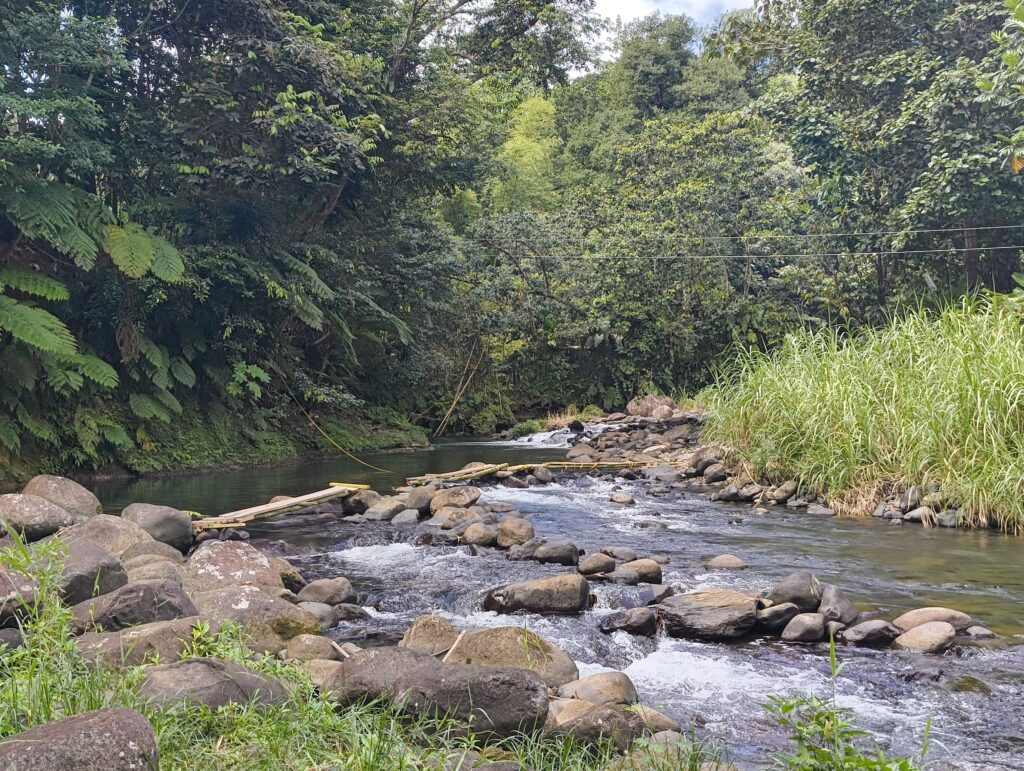
The journey across the river is managed elegantly by Tash. A slack rope provides something to hold on to as the water reaches up to her thighs and the smooth rocks, flickering beneath the clear water, are easily negotiated by her beach shoe clad feet. When the river starts to run brown, you might have five minutes before it’s a roiling turbulent barrier to passage.
A chair hangs over the river, suspended from a zipwire. I have seen it used, but I think it’s not for me. Further down the river a partial foot bridge has been made. The crossing there links more closely with Edo and Girlie’s home.
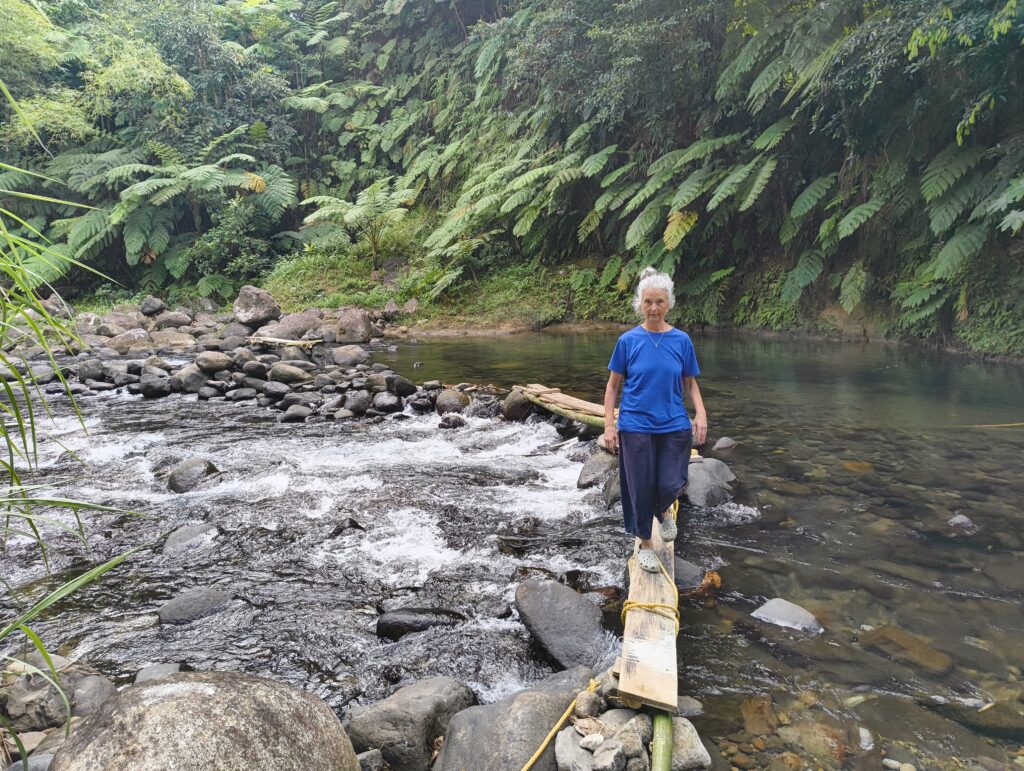
It is a one man show on a grand stage. The spotlight of the sun on the water’s surface, the flickering reflections occluding the underwater path, my naked feet slipping and softly vulnerable to the uneven terrain, the rope which can be held but cannot be leant on. I am my own audience, rapt with the comedy and tragedy of a shuffling, tottering progress. It is almost unbearable to watch. But the far bank is gained, and I wring out my drenched pride and start to climb.
Steps are cut into the soft earth, and then a path, lined with fruit trees and coconut palms, leads up to Eunice’s. She keeps the trail, and the centuries old stone steps, clear, with a cutlass and a brush. Her face knows nothing else other than a smile, says Sebastian. She greets hikers with this smile, this bright burst of energy like the flowers riming the bush.
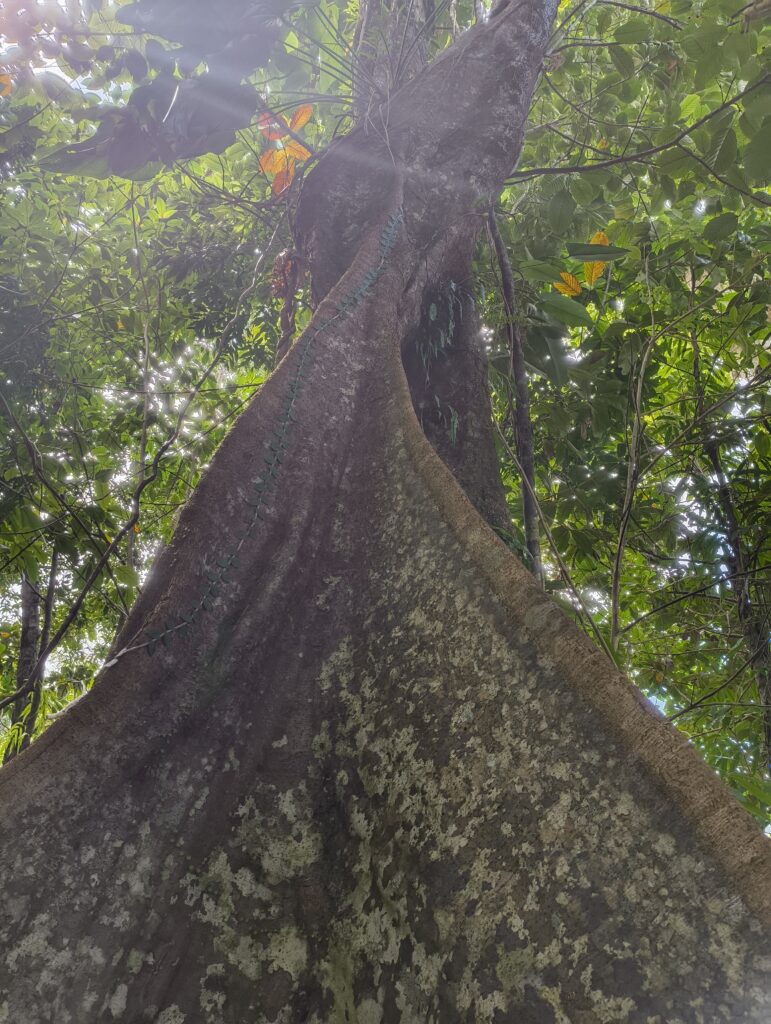
We continue on up the steep path. The trees and vegetation on either side seem relaxed and at home in their vertical growth, whilst I am a huffing and puffing contrast as I lean into the hill. A huge gommier tree waits at the top, it’s buttress roots like the tail fins of a whale, grey, smooth and massive. I imagine this tree propelled upwards with the giant force of a flick of this tail.
Here are the flats. Either side of the path is bush, rainforest, darkening within feet, the tangle of roots, fallen leaves and wet earth running away in all directions. I am amazed by how close the darkness approaches, like I can reach out to touch it. But my eyes adjust, slowly, and leaves and flowers with their oranges and rusty reds and strands of yellow pick themselves out against the resolving dark green canvas. Look deeper.
The container is full of jumble, a semi sorted mass of the necessary, the useful and the yet to be identified. Nick, we need shelves there, says Edo. I come up with a plan involving ply. No, no, no, use the lumber we have, he says. I look at the stacked boards, harvested from the partially dismantled building, cut with a chainsaw. I have never made shelves from tropical hardwood. I search for a straightedge. I try to cut some bits square. My plan seems to involve a lot of waiting. The workforce around me are making the formwork and the reinforcing cages for a concrete pad. I know almost nothing about concrete structures and increasingly marvel at the skill, precision and understanding they have. The cats cradle of lines for uniform planes enchants me. It is sunny. It is rainy. It is hot. I am shy and in search of a blessing of competence. I wait, watching the different iterations of jeopardy play out in my mind.
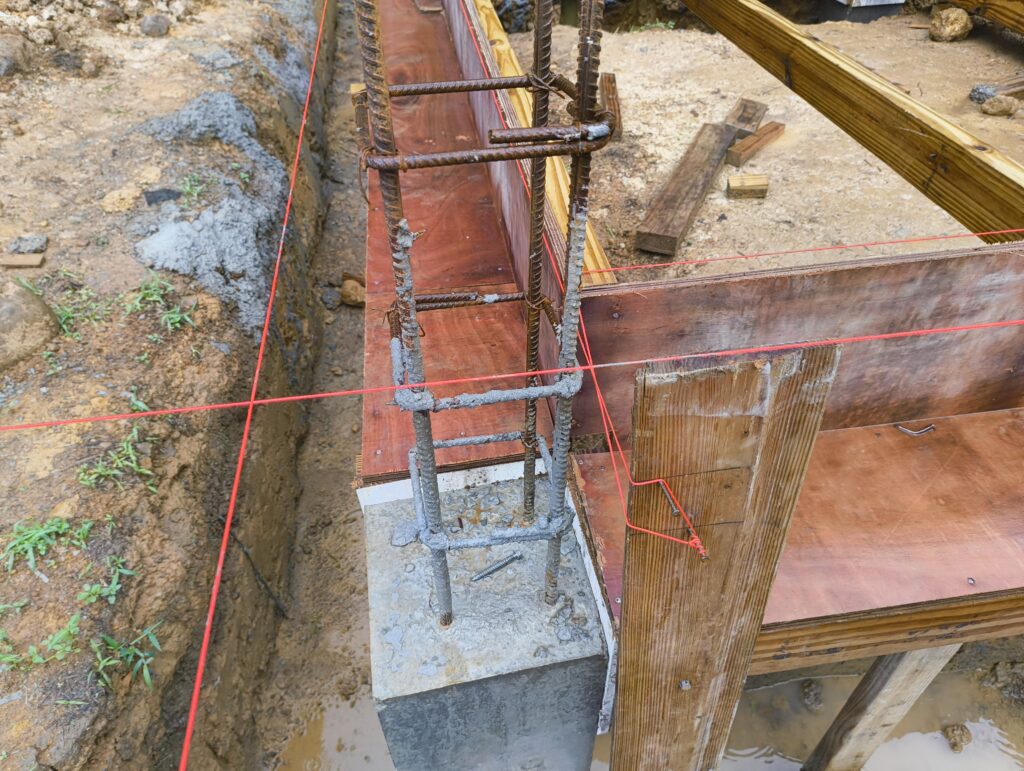
The container is still chaos. It is impossible to step inside. I imagine a process for regulation and order. I imagine not doing myself any harm.
The track down to the site from the road was cut by Mal some thirty years ago. There is a point as I turn off the road, when I am at the top of a rollercoaster. The bonnet of the car obscures the track, are the wheels in the right place, and then over the crest and down the first steep section, precipitous drop to one side, my foot nursing the brakes, no skidding, immovable rising bank to the other. The surface is tarish, the go to stony aggregate on island, here just spread three or four inches deep on top of the earth underneath. In a few places the track narrows and I stare resolutely ahead. Concreting this track has risen up the list, deliveries can or cannot be made depending on the rain. Where to start, when to do it. It’s a little tickleish, says Edo.
We have been warned off the Layou road. It has not been repaired since Maria, but heading back from the coast one afternoon, we decide we’re up for an adventure. The road is flat, smooth and runs alongside the broad Layou. Huge boulders litter the river bed, rapids giving way to slow tree reflecting stills. The forest is dense on either side, a graveyard of giant excavators appears and then is gone, submerged in the greenery. The road curves away and then back at right angles as we approach a bridge. Five or six cars are parked up by the riverside and music, food, drink, laughter, dance and merge with the twinkling river and the sunlit trees. The road climbs steeply and is no longer really a road. Occasional islands of tarmac appear, but the rest is like a dry riverbed. A small car ahead, is slowly climbing the rubble strewn route. This road was bombed by Maria, and it’s fractures and fissures subsequently scoured out with eight years of rain. One side is steeply sloping up, on the other the crumbling remnants slide down to the river far below. Still, our 4 wheel drive hulk follows the path of the little car ahead, lurching and growling as we go.
We come to a village, Layou Park, not enough of something to warrant a navigable road, it seems. A pristine three storey block appears, a swimming pool, clear and humming from its pump, part of it. I get tangled briefly between enormous and anomalous. Enormously anomalous. Later, I study Google maps. It is not there. The road continues it’s war torn wretchedness for another mile, but at the Warner junction, smooth tarmac reasserts itself. The road is like a ribbon of black coarsing through the dense green. It’s margins are unswiped and the gullies and ditches lining either hide unknown deeps. If I can stay on the ribbon, there will be no bumps.
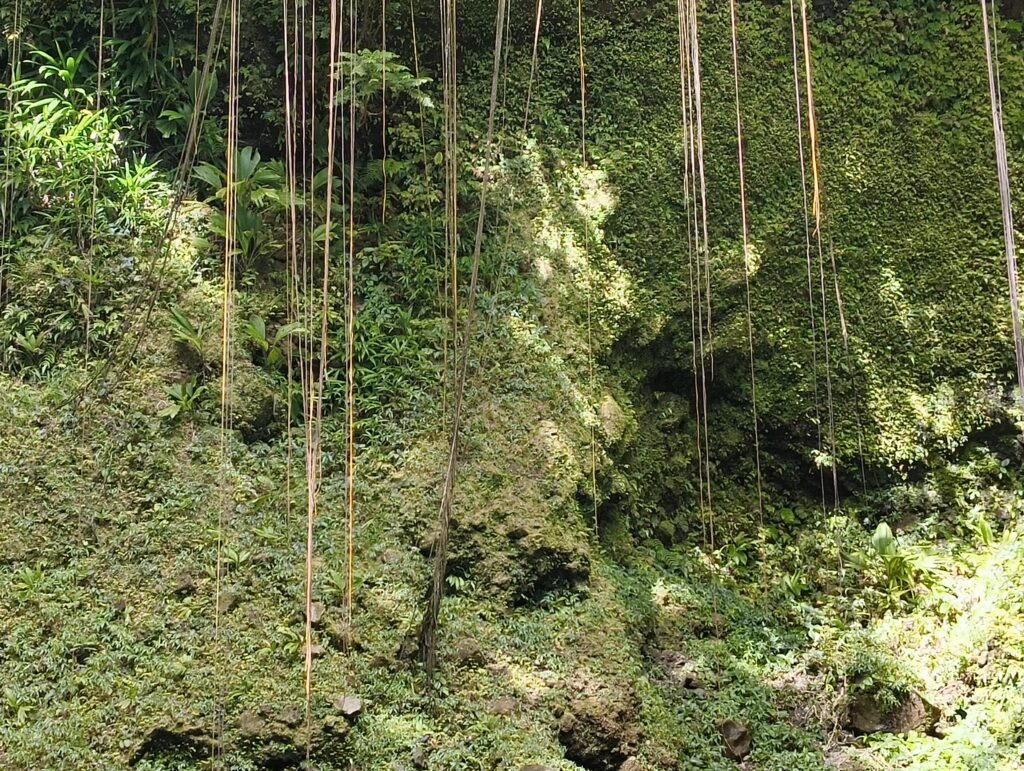
Walking along the track through the flats, we are both struck by the absence of animal hazards. Nothing will sink it’s teeth into us, no voracious predators lurking in the gloom, nothing venomous. We reach the edge of the flats and the path narrows and heads down along a ridge. I do not look to the side. Then the steps appear, three foot high, hewn with hammers and chisels, two hundred years ago. They follow the spine of ridge down to the river below. Tash and I pick our way along the river’s edge, wading through the shallows where we must, the water is cool and clear. Cliffs rise on both sides, trees and ferns growing on anything just out of vertical. At a bend in the river large rapids, and deep pools thwart our progress. From here it’s a half hour walk and wade up the river back to where we started. But with a bag each, we are ill prepared. So we return to the steps and climb back the way we came.
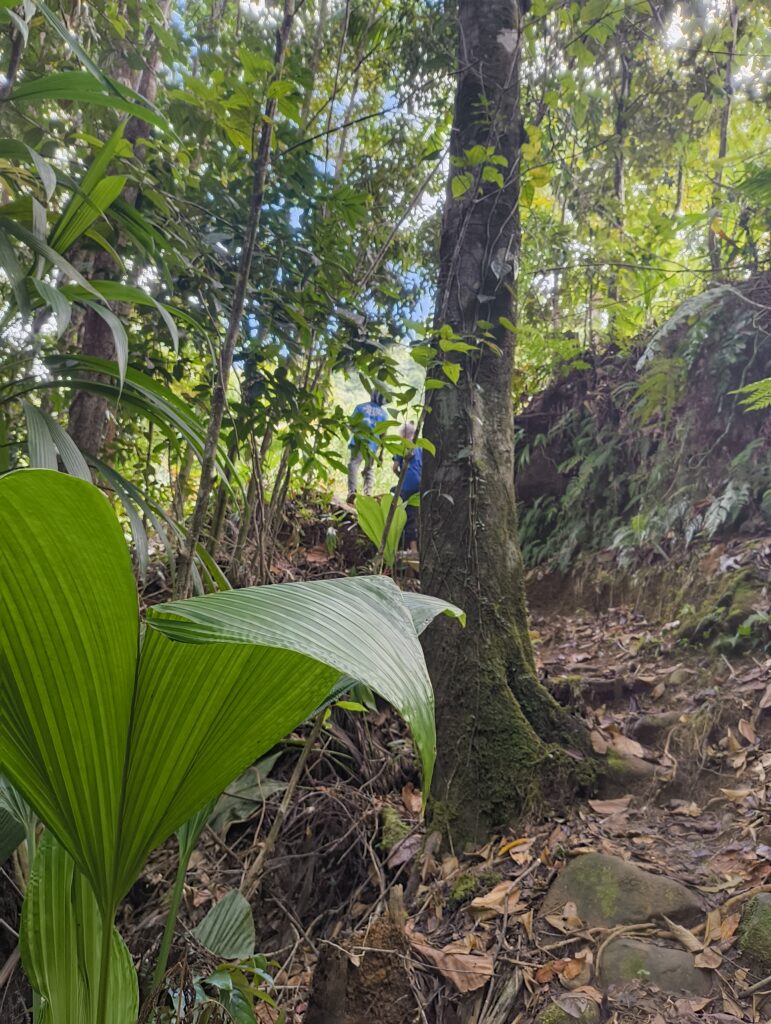
Quite suddenly the waiting is over. There is a lull on site and only Tash and I are there. We empty the container, assemble the shelves, stack and sort and hang and label.
All is good.