We turn off the highway onto a track. Two tethered goats bleat, a cow looks up, a house, all lilac and purple, stands behind a metal gate. The yard has a number of vehicles: cars, trucks, pick ups. It’s hard to tell if any work or ever will again. Dogs bark, growl and yap. The largest and fiercest is tied with a rope. He does not want to be my friend. We are waiting for Jolly, the man from Dowasco, who can arrange a water connection. He lives upso. I reverse back to the highway and park opposite. A dead concrete mixer truck keeps us company. I peer down the bank and see a large well tended garden, neat rows of cabbages, lettuce, onions, completely hidden from the road.
We will have a form to fill out to get a water connection. The space for the address is troubling. There are some road names, Dr Nicholas Liverpool Highway, for instance, but no one uses them. Instead, destinations are used, Canefield, Marigot, Warner. There are no postcodes, no house numbers. After a while we realise the address we should use is Belles. This is our village, a couple of clusters of houses spread out along five miles of road, population five hundred. How will we specify where the meter should go?
A few cars whizz by. No Jolly yet. We’ve been told to get three quarter inch pipe to run from the meter down the steep slope to the site. Three quarter inch here corresponds with twenty five millimetres. Imperial measurements are securely dug in to the island. Feet, yards, inches, gallons, BSP, PSI. The very occasional speed limit signs, 30, relate not to miles or kilometres per hour, but according to the police, whatever your speedometer says. Conversion tables, exchange rates, time, all become functions of something like quantum theory. In my head, twenty five mm is an inch, but I must let that go.
A man in wellies, a large bundle of something green under his arm, and a cutlass in his hand, walks along the road. Jolly back soon. People walk miles, for hours. Or they wait for a ride, for transport if they’re travelling down, to town. The keyboard in my head has sticky keys, a number punched in recurs endlessly and the necessary computations for quantities, distances, costs resolve themselves briefly, before evaporating into air. Time might be measured in familiar units, but it’s passage, well, you step onto a bridge marked next week, but when you get to the other side who knows where you’ll be.
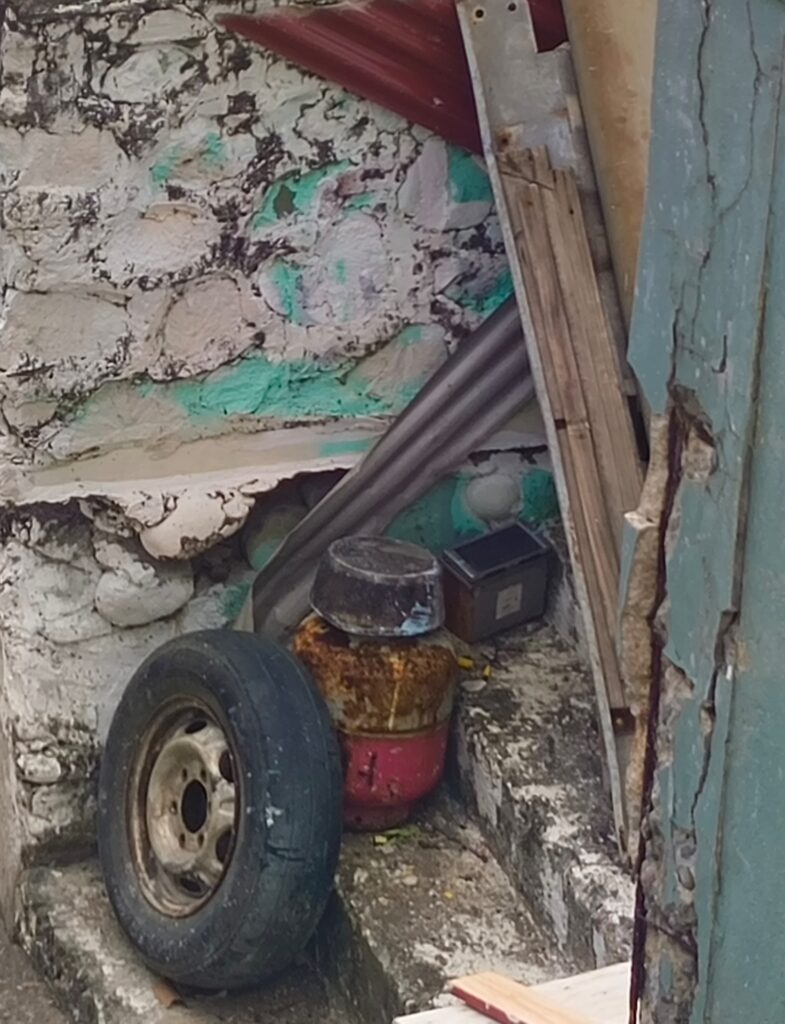
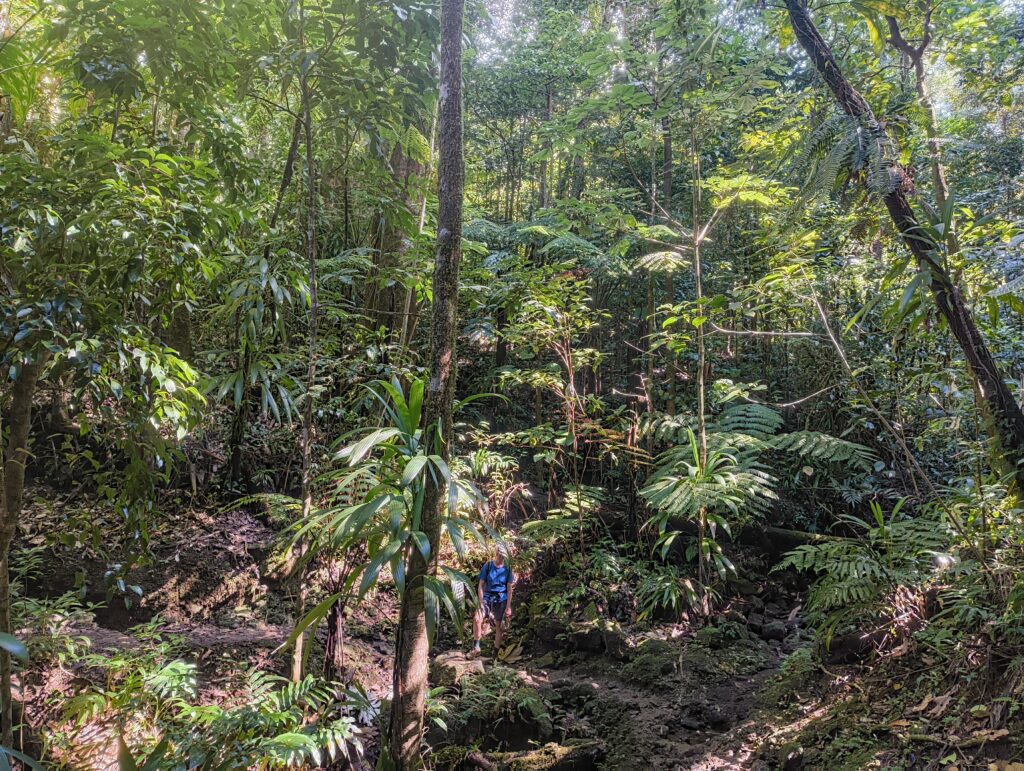
I can see six or seven houses from our waiting spot. A couple of ruins. All concrete structures, some complete, bright and sharply painted, some on their way up or down, some two storey, on or near the road, which here runs straight and level for a mile or so. These small plateaus are called flats, bounded by ravines on one side and steep forested slopes on the other. They were home, until the early nineties, to extensive banana plantations, vegetable plots and provisions – mainly dasheen, the great staple. Geest bananas went to the UK. Until the market changed. Livelihoods changed with it, and whilst the land waits, the bush doesn’t.
A pick up turns up the track. We drive up behind and greet Jolly. He is smiley, roundish and strong. We explain that we are here to collect the form for a water connection, Edo, the rasta, had mentioned it to him. Oh, the rasta that loves Mal’s daughter, up by Jacko. Yes. Ok. He heads off to the house, and it starts to rain, and then rains hard. He comes back five minutes later, a towel over his head, the forms were hidden beneath Christmas decorations. It’ll take a week. And a copy of the marriage certificate, and the land registry, and a trip to town to the office to pay the fee. It feels like progress.
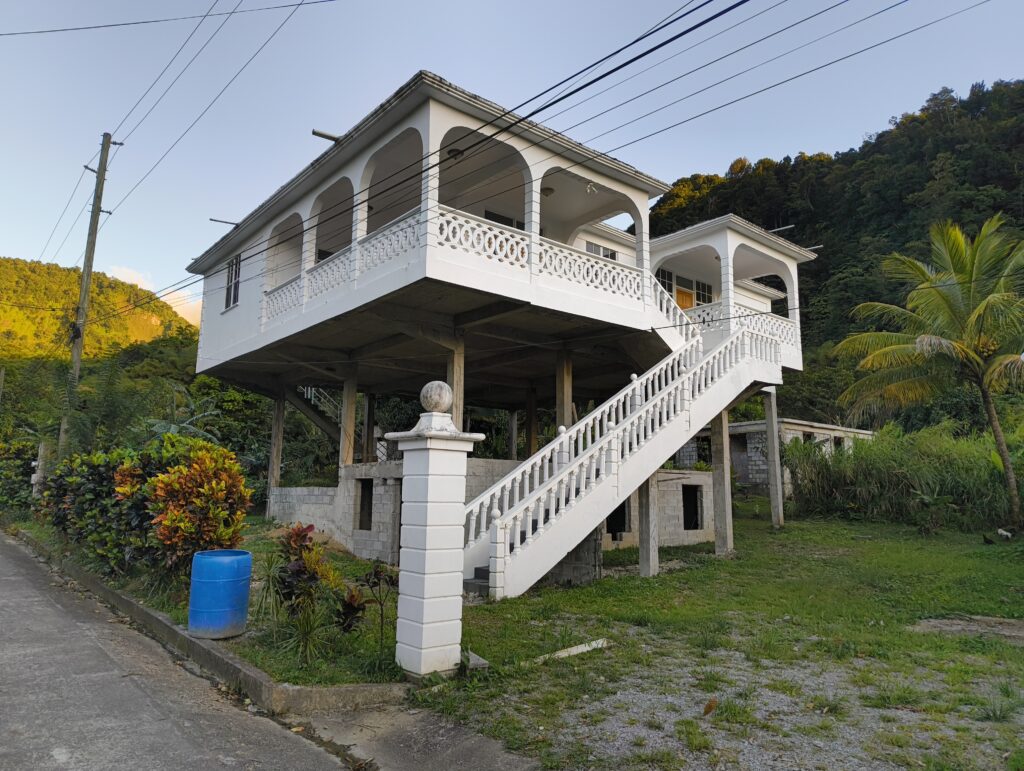
I have the pipe and we put a stick in the ground with a plastic bag tied to it to indicate where we would like the meter. I imagine this as an address. I buy various fittings, all of which look doubtful, but I remain hopeful. These are the poles of progress: I am hopeful because I go to bed with the ducks lined up, by morning some have flown off. Waiting becomes an active part in any undertaking, time will unfold at its own pace.
The swiping crew are working their way down the road clearing the growth back a couple of yards from the tarmac. Two brush cutters, rakers, sweepers, a gang of ten. How often do they do this, I ask Edo, once a year? He laughs, maybe every month or so. The rapid, relentless growth obeys it’s own clock. Gullies, ditches, concrete culverts, the ruins of machines are revealed as the crew make their way along.
Eunice chucks the seeds from her fruit where ever. Cacao, papaya, orange, coffee, all get spread around her home. I just throw them down. When I see them as little plants, she says, I lift them and plant them where I want them. Her home is a factory of drying seeds and pods, the beginnings of plants in their modules, processing and a place of welcome.
The land is a nursery. We too are taking root.