
When it falls, the world turns upside down. The sea is above my head, the rolling grey mass of cloud dissolves the green wooded slopes, and the firm earth runs it’s many courses towards the sea. The air roars. Leaves dance, deflect and tremble. Streams run down the trunks of trees. The sound of boulders, dislodged from their river bed garrison, tumbling downstream, is the low thunder of land powerless against the rushing urgency of water.
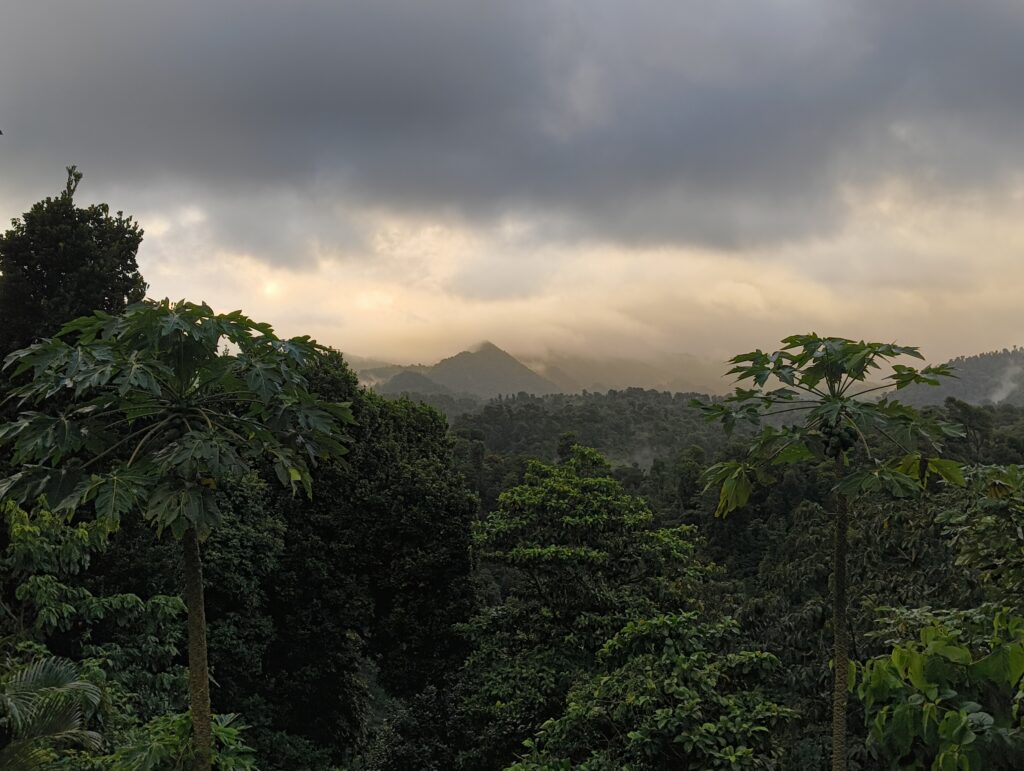
Nothing dries.
There is a resistance in me. A puny frustration at the wet immensity. I scan the horizon aboard a raft of cliches – it is what it is, go with the flow – for a glimpse of land. This is normal, but not yet for me. Clearing, planting, harvesting, building, work in all it’s joyous forms, carries on. I am taxed by puddles.
We are directed to Edwin as we leave the tiny terminal of Dominica’s airport. He is my senior by some years, elegant, unhurried and welcoming. It is dark beyond the lights. His shiny black nine seater looks immaculate. I think forward to the end of this journey and the turning off the road we must take, four hundred yards of cratered boggy track, and wonder if he will leave us and our wheeled luggage to it. Just as we set out, we collect an extra passenger, an airport employee. They gently murmur to each other as we drive into the night. The road winds along the coast, briefly smooth, then climbs up through the village of Marigot, steep switchbacks and very ruined. This is the road from the airport. We pass two or three cars, Edwin gently navigating tyre and wheel wrecking holes. I keep thinking of the track ahead and his immaculate import.
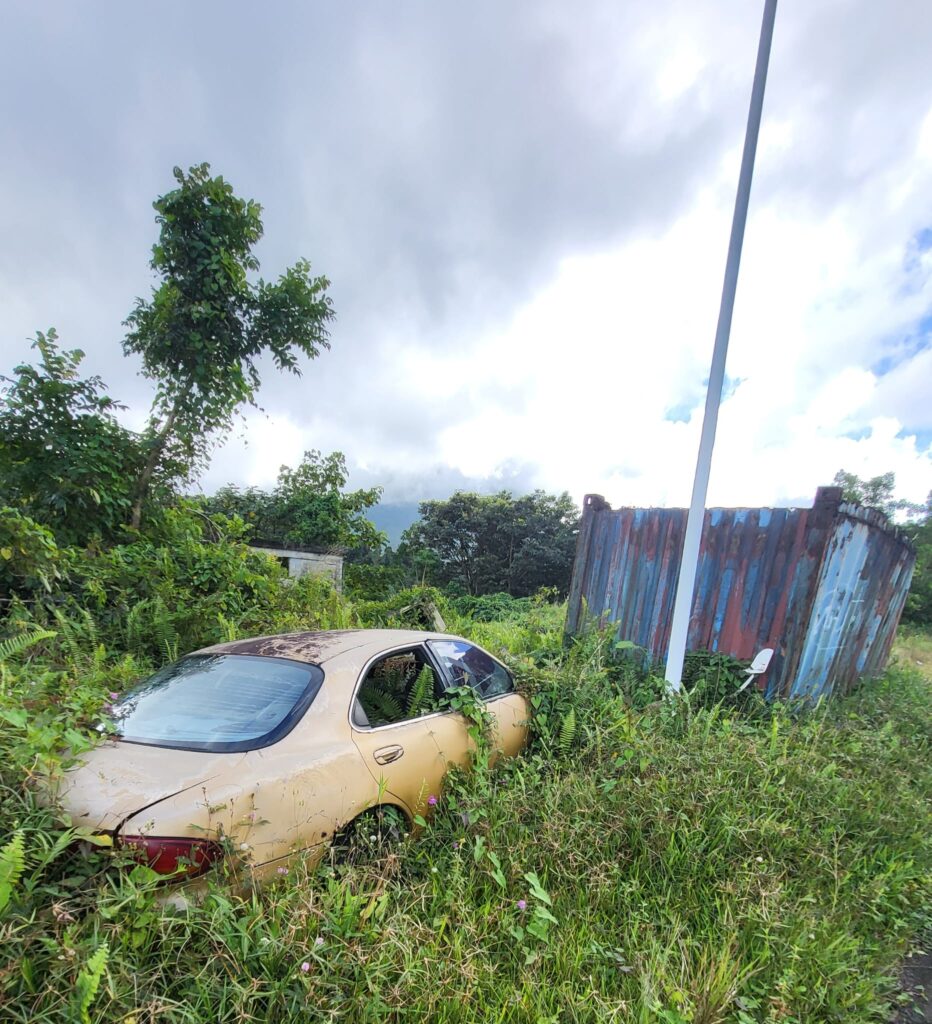
It’s a journey of forty minutes up to Bells, a village in the middle of Dominica, surrounded on all sides by the mountains that are the spine of this island. In November, at five in the morning, it had taken thirty, eternal minutes. Our driver then, Williams, had lit a huge bifta as we gathered our bags. His first priority as we set off, was to select a video to watch; his second, to glance occasionally at the curving wet road ahead, whilst talking possibly faster than our descent. Tash closed her eyes, whilst I averted mine.
Edwin knows the turning, at the top of a hill, on the corner of the last bend. He eases down the curb, his headlights revealing the lie of the land, all bush and trees and puddles. In the front they murmur – never been down this way, I often pass, hmm – he navigates the sudden dips and bumps calmly, not troubled by the track, slowly slowly. At the end, a small turning space of mush and mud. He is not perturbed. We are here, at Parrot’s Nest, our home for two months.
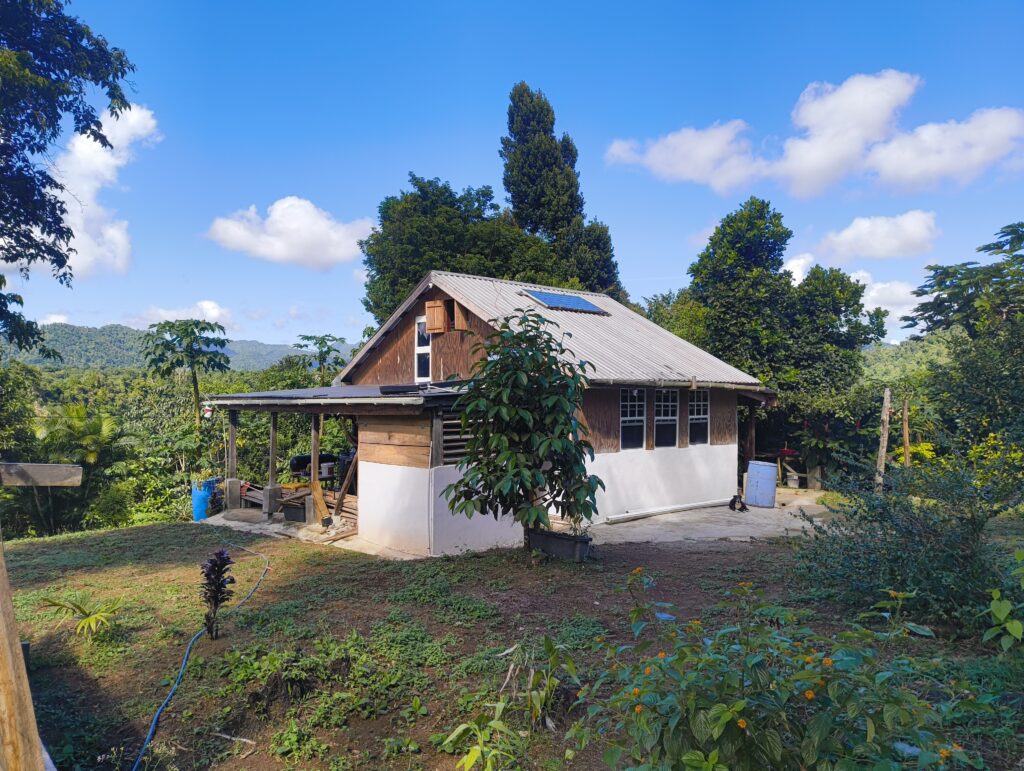
I am staring at something green. Mexican coriander, says Tash, smell it. Ah, yes. In moments, it will return to it’s variegated green canvas, and I will be none the wiser. Names are caught in the air, like puffs of morning mist rising from the rivers, too soon evaporating into the landscape around. Carapit, Loriea Poive, Samon, Bwa Diab – I nod along, yes, yes. It will be a while yet before any of it sticks. I want to know, but, as with much else, my understanding lies just out of reach.
The river beneath generates noise enough to drive a turbine, even a hundred and twenty metres below our cliff edge nest. Our cabin is five metres from a forty metre drop, the remainder down is barely out of vertical. But covered in trees and ferns, it’s brutal descent is softened. The view across to mountain slopes, shows shadows cleft against the green swathes and the ravines and ridges scored deep and high. I do not like heights and anxiously peer through the boundary of Carribbean hedgerow. All I can see are trees and leaves and shadows.
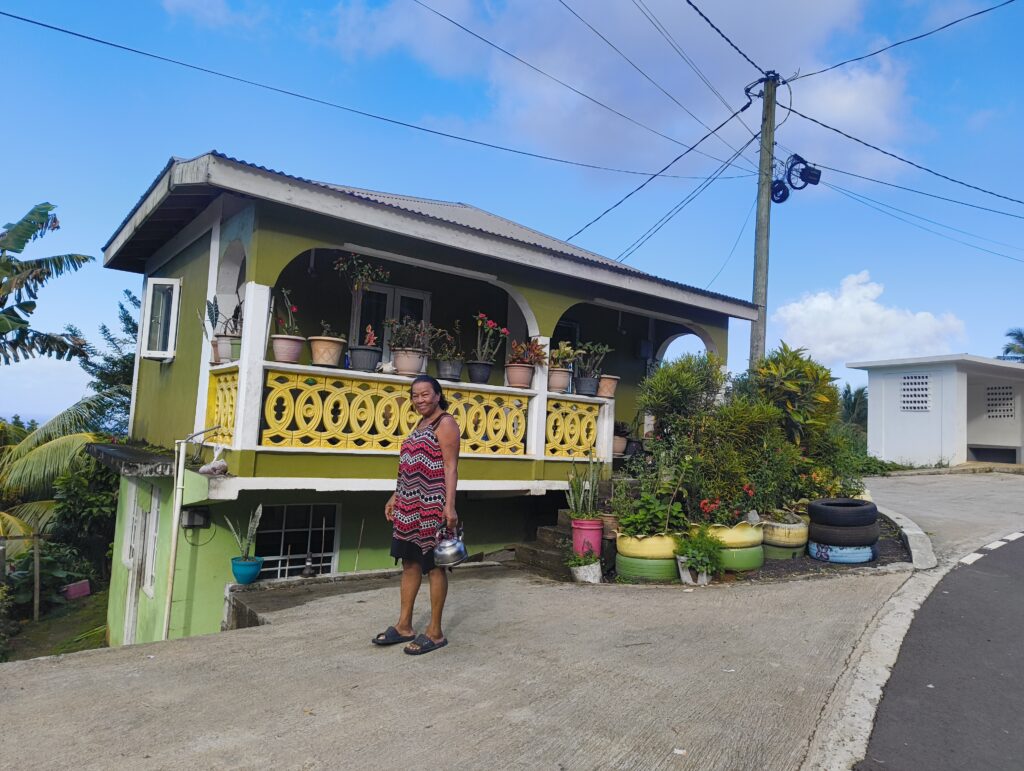
The view across is to Jacko Flats, a plateau bounded by steep slopes rising up from ravines on three sides and a summit behind. From a corner where two rivers meet, a narrow ridge climbs sharply up and steps two feet high have been cut into the rock. This was the route to safety and Chief Jacko’s camp for escapees from the plantations. Raids on those plantations, smokeless fires, a sure knowledge of the mountainous rainforest landscape, trade and exchange with the Kalinago, made them a long-standing thorn in the ambitions of the colonisers.
I acquaint myself with stories, timelines, geography. Some characters survive, under glass as it were, whilst others are like the tattered fragments of handbills nailed to a tree. Stepping back, all seem no more than the faintest mark on the green glazed surface of the island. As I am slowly folded into the land, my footholds in permanence subside. The road ahead is swept away by flood or landslide, and, with it, all the massive works of human mark making disappear. David, Erica, Maria – the most recent hurricanes to shape the land and the lives of those that live here. They are reference points that underscore the impermanence of everything; the leafless trees, the collapsed mountainsides, the marooned and destroyed villages. The physical and technological infrastructure is a gossamer filament. Sooner or later, the elements will lay it to waste. But renewal is permanent. After Maria, within three years, the ravaged, barren and shredded forests were green again. Gardens tended and productive even quicker. Nature and people get on.
Our first lessons are about how that might be done.